
- How to Compare Credit Cards: A Comprehensive Guide - November 10, 2026
Applying for a credit card can be a crucial step towards building a strong financial history and preparing for future borrowing. If you’re smart about how you’re using the card and pay most of your balance off each month, you could save money through rewards.
With the countless number of options available, it is difficult to know where to begin your search. However, your goals, spending habits, and preferred card characteristics narrow your possibilities considerably. Plus, you won’t qualify for every card anyway, as they all come with their own credit requirements.
The process of choosing an appropriate card can get complicated fast, so it’s important to know what to look out for. When comparing credit cards, here are the factors you should weigh.
Credit Card Comparison Checklist

- What is the type of card? Rewards, secured, student, store, business, or other?
- What rewards does the credit card offer? Cash back, points, miles, or none?
- Does the credit card have an annual fee? If so, what is it?
- What is the credit card’s APR?
- Does the credit card have a 0% intro APR period? If so, how long is it?
- Does the credit card have a welcome bonus? What do you have to do to earn it?
- Does the credit card charge a foreign transaction fee? If so, what is it?
- If you’re transferring your credit card balance, does the card have a 0% intro balance transfer APR period? Is there a balance transfer fee?
- Does your credit score fit into the card’s recommended range?
Types of Credit Cards

Not all credit cards function the same way. Some of the most common types of credit cards you’ll encounter are:
- Rewards: Rewards cards allow cardholders to earn cash back, points, or miles. Some provide higher rewards than others, and redemption options can vary. Many credit cards offer some sort of rewards, although cards targeting those with poor or no credit may not.
- Secured: Secured cards allow those with poor or no credit history to build credit. With a secured card, you’ll need to put down a security deposit, which will often be equivalent to your credit limit. Common minimum deposit amounts are $200 or $300. After you establish a track record of making consistent, on-time payments, you’ll get the deposit back, and you may be able to upgrade to an unsecured card.
- Student: Student credit cards are a type of unsecured card tailored for those enrolled in higher education, and you may need to provide proof of enrollment. These cards are usually easier to qualify for, frequently accepting applicants with no credit or an otherwise limited credit history. They tend to have a lower credit limit as well.
- Store: Store credit cards are issued by specific retailers. Sometimes, you’ll only be able to use the card at that store, while other store cards can be used anywhere. However, rewards may still be higher at the issuing retailer. Approval can be easier with a store credit card, though interest rates exceed those of other unsecured cards.
- Business: You can use a business credit card to pay for business expenses. Business credit cards usually have credit limits that are higher than those for individuals, and some rewards programs are also business-specific.
Reward Structure

One of the main reasons people use credit cards is to take advantage of the rewards. Reward structures vary, so you should try to choose an option that best aligns with your spending habits.
Cash Back
Cash back credit cards have the most straightforward rewards structure, making them a popular choice for those new to credit. You earn a certain percentage of your purchases back, usually as a statement credit to reduce the amount you owe.
Some cash back cards apply a flat rate to all purchases, usually between 1% and 2%. Others have tiers, rewarding certain spending categories at higher rates. These categories may be static, rotate periodically, or be customizable.
Points
A points credit card rewards you with points rather than cash back. You can choose how you redeem your points, deciding between travel, cash back, charitable donations, gift cards, or other options. Usually, you’ll earn at least one point for every dollar spent.
The value of one point tends to hover around one cent, though it can fluctuate. As with cash back cards, some point cards use a flat-rate calculation, while others have tiers for certain categories, adding a multiplier, such as 5x.
Miles
Travel rewards cards often provide rewards in the form of miles. Cardholders mainly redeem them for travel-related purchases, such as airfare, hotel rooms, or rental cars, though you may also be able to redeem them for cash back, gift cards, or other types of rewards.
Some miles are tied to a specific airline, while others are not. You may also get more value out of your miles by redeeming them through your card issuer’s travel portal, if applicable. Miles operate similarly to points, with typical values of one cent each.
Annual Fee

While many credit cards have no annual fee, some do, especially those with the most generous rewards. If you’re interested in a card that charges an annual fee, you’ll want to consider how much you plan to use the card, along with the rewards you expect to earn, to determine whether the card will be worth it to you. If you anticipate that you’ll use the card only minimally, the rewards may not outweigh the fee. There is a wide range of what the fee may be as well. Some annual fees start around $50, while others cost several hundred per year.
Rewards vs. Annual Fee: Doing the Math
Suppose that you have a cash back credit card with tiered rewards. Groceries and gas are rewarded at 3% each, while all other purchases earn a 1% rate. The annual fee is $50, and you spent $3,000 on groceries, $1,000 on gas, and $1,000 on other expenses.
In this case, you’ll get $90 cash back from grocery purchases, $30 from gas, and $10 from other purchases, so your rewards would total $130. Less the $50 annual fee, you will come out ahead by $80.
APR (Annual Percentage Rate)

The APR, or annual percentage rate, is the yearly cost of borrowing funds with a credit card. Often, it’s referred to as the interest rate. Compared to other financing options, credit card interest rates are among the highest. Without paying down your balance each month, you risk accumulating substantial debt.
Credit card interest rates vary depending on your personal credit profile, the specific card, and overall market behavior, but can be as high as 20% or more. Applicants with the highest credit scores can achieve the lowest interest rates.
If you make complete, on-time credit card payments, you won’t have to deal with the effects of your credit card’s APR. However, it’s still important to know what it is in case you ever miss a payment or can’t pay your balance down.
0% Intro APRs
Many cards have a 0% introductory APR period for new cardholders. During this period, which can be anywhere from six to 21 months or more, you won’t be charged any interest on purchases. There can also be a 0% introductory balance transfer APR period, which functions the same way. You won’t be charged any interest on your balance transfer during this time. Cards that have 0% APR periods for both purchases and balance transfers may set the same lengths for both, or they can differ.
Welcome Bonus

Many credit cards have welcome bonuses you can qualify for by meeting certain criteria. Usually, this involves meeting a certain spending threshold within a set amount of time. For example, you might see a bonus where you’ll earn an extra $200 cash back if you spend $1,000 in the first three months. There can also be welcome bonuses for points and miles, not only cash back.
Churning
Some people open several credit cards to take advantage of the welcome bonuses, a practice referred to as churning. They’ll regularly open new cards and close old ones before the next annual fee comes due to maximize benefits. However, frequently opening and closing cards could cause your credit score to take a hit in a variety of ways. Plus, many card issuers impose limits on the number of cards you can open within a short period of time.
Foreign Transaction Fee
Foreign transaction fees are fees charged by your issuer for purchases made in other countries or at an international company’s online store. Usually, the fees range from 1% to 3%, and they can add up quickly. If you travel often, it could be worth applying for a card that has no foreign transaction fee.
Balance Transfer Offers

A balance transfer, where you move your credit card debt from one card to another, can help you reduce your debt and pay a lower interest rate. While many credit cards allow for balance transfers, offers may vary. It’s common for there to be a 0% intro APR for balance transfers, which can help you avoid accumulating further debt.
Sometimes, you’ll be charged a balance transfer fee. These fees can range from 3% to 5% of the amount being transferred. If you’re planning to transfer your credit card balance, prioritize transferring to cards with 0% balance transfer intro APRs, along with no balance transfer fee.
Credit Score Requirements and Pre-Approval

Looking beyond your own wants and needs, some cards won’t be available to you simply because of your credit score. If your credit is bad or you have no credit history, you may have to start out with a secured card. Some secured cards still provide rewards, though they tend to be lower than unsecured credit cards.
Cards with the highest rewards potential have stricter credit score requirements. Plus, if your credit score is high, you may be offered a lower interest rate and higher credit limit.
Before applying for a card, you should research and see if your credit score is within the recommended range. You may also want to apply for ones that you’re pre-approved for, as pre-approval signifies that you’ve met a card’s basic qualifications. Both of these actions can increase your odds of approval the first time around, minimizing the number of hard credit inquiries. Hard inquiries will temporarily reduce your credit score.
Comparing Credit Cards Online
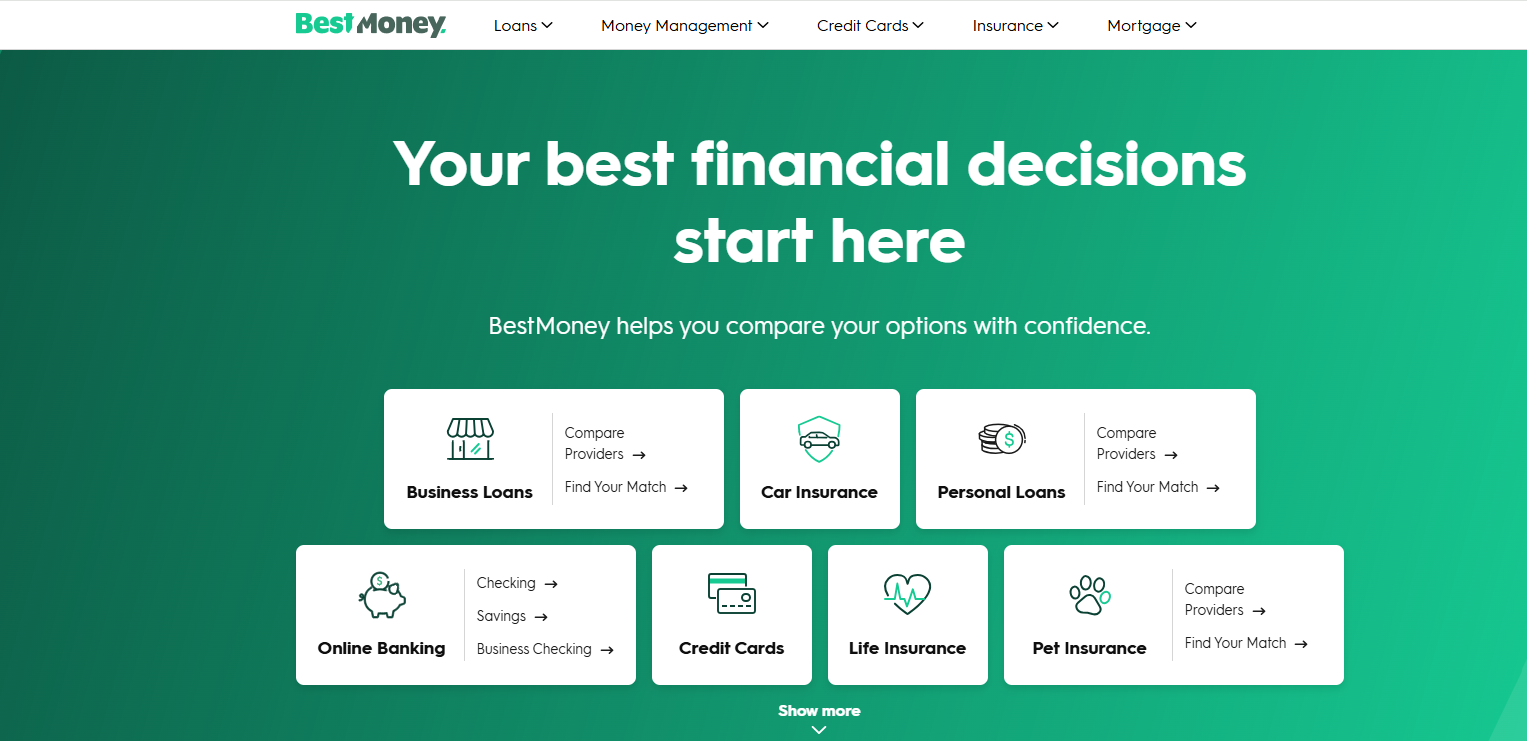
To get a well-rounded view of the current credit card landscape, you can visit financial comparison sites. Comparison sites, like BestMoney, NerdWallet, and WalletHub, let users research a wide range of financial product categories, with credit cards being one.
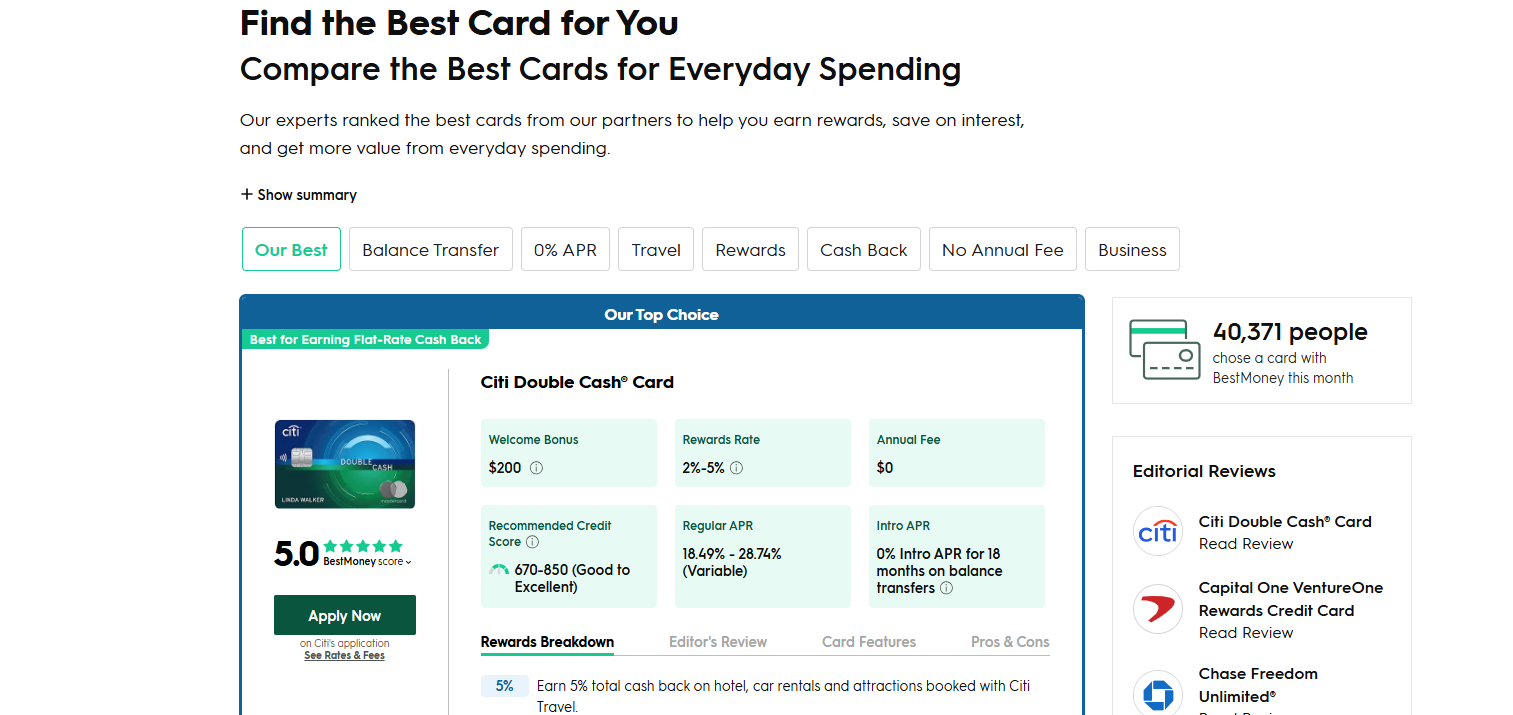
You can filter based on the type of card, such as cash back, balance transfer, 0% APR, travel, no annual fee, or business. These sites clearly present each card’s APR, recommended credit score, annual fee, and other characteristics, making it easy to view your options side-by-side. Also, they publish in-depth credit card reviews, so you can get an idea of whether a particular card is the best fit for your financial situation and your goals.
Start Comparing Credit Cards Today
If you’re new to credit, terminology like APRs, points, and balance transfers can seem confusing. Even if you’ve had several cards before, it can still be a challenge to know which features you should seek out and how they fit into your overall spending habits.
For those without a credit history or who are trying to rebuild their credit, you may need to start with a secured card. Those with higher credit scores can be more selective with rewards structures and fees, making it imperative to choose a card that best aligns with how you spend.
Regardless of where you’re at in your credit journey, it’s important to do your research before applying to reduce the likelihood of denial or choosing a card that won’t help you reach your goals.


